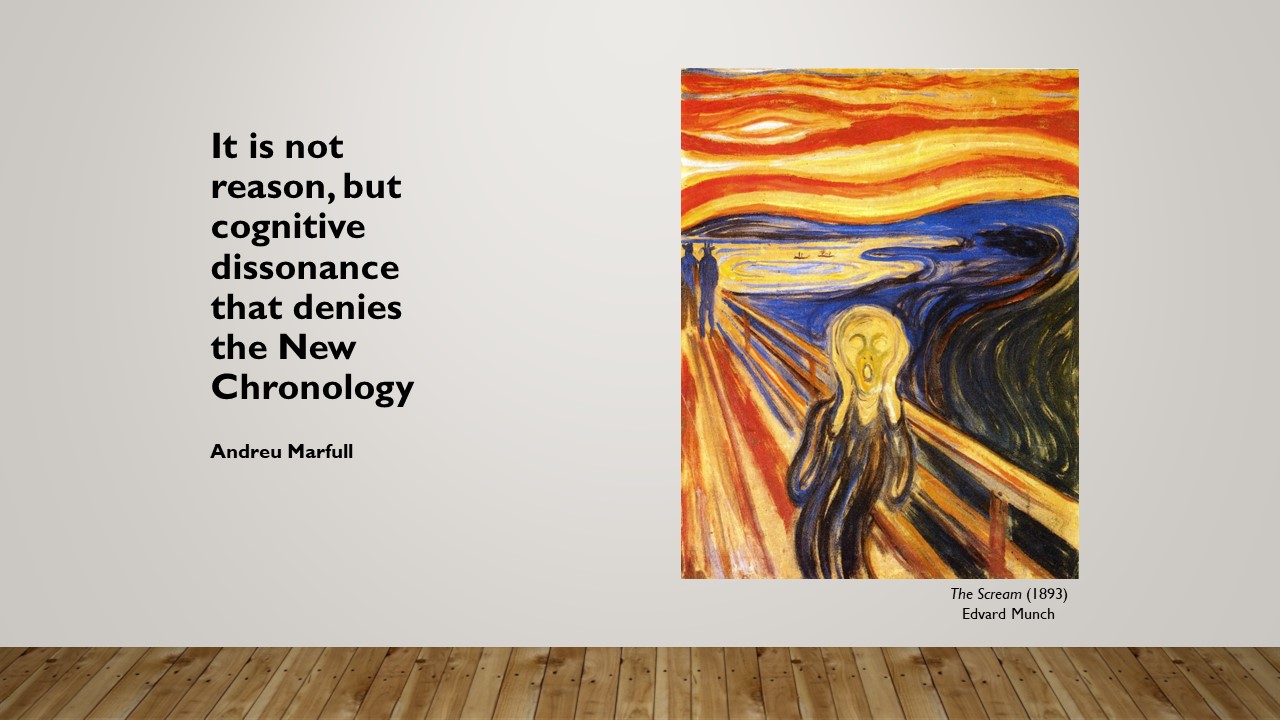
It is not reason, but cognitive dissonance that denies the New Chronology
This paper analyzes the reason for the resistance to accepting an alternative historical reality, which demonstrates that, from Europe, an official history was imposed based on a manipulated and dilated chronological map, coinciding with colonization, the Holy Inquisition and the Enlightenment. It is the New Chronology of Fomenko and Nosovskiy.
It can be understood that it is difficult to accept that the chronology of history has been extended, and that, therefore, history has been manipulated. But what is not so understandable is that astronomical, statistical, and documentary evidence is presented, plus associated clarifying work and reasons that explain why this manipulation has been done, and instead of stopping to listen and giving the benefit of the doubt, you choose to block the dialogue. Discussing and questioning proven scientific research falls within the space of reason, but another thing is the irrational denial that resists being raised unilaterally.
Egyptian temples and many temples considered Christian (European), as well as documents of different origin and nature, have zodiacs that express a single date, and these are found, as far as Ancient Egypt is concerned, in a past no older than thousand years, and, as regards the Middle Ages, in a past no more than six centuries. Furthermore, numerous biblical and historical facts attributed to antiquity overlap in medieval events. The statistical analysis of genealogies and historical facts corroborates this, by detecting numerous duplications between antiquity and the Middle Ages, with recurring jumps of just over three, ten and eighteen centuries. On the other hand, medieval documentation that recounts ancient events with clearly medieval iconography, about episodes such as the Trojan War and ancient Greece and Rome, points in the same direction. That is to say, it is demonstrated that truly documented history has been used to send duplicities to the past, to lengthen it. Thus, Ancient Egypt and the biblical events are much more recent, and it can be argued, with grounds, that ancient history is also part of medieval history, and that medieval history is more recent and did not last a thousand years, as established by the official history. This information is not the result of speculation, and there is no possible margin of error: history has been artificially manipulated and dilated.
The existence of a huge archaeological and documentary falsification, which has been accepted as false, indicates that there are indeed traces of this manipulation, but in reality it is much greater than is thought. The burning of books by the Inquisition, the blacklists of prohibited books and the looting and intervention of all unimaginable libraries is part of this process. This was the case until the 19th century. Furthermore, the profusion of genealogy and heraldry books from the 15th to 18th centuries, which have been incorporated into historical consciousness as valid, are further proof of the artificial construction of a documentary past. This set of evidence is eloquent. And it is even more forceful to remember that the entire museum construction of ancient Egypt, about which we present objects and history, has been elaborated since the 18th century, not before. It is at that time that the history academies appear. Similarly, there is the case of encyclopedias, born in the 18th century, which, by the way, originally lacked sources. In fact, the story is based on a supposed documentary base and chroniclers, but they are not necessarily primary sources. Ancient history, which leads us to the classical Roman Empire, is based on hundreds of chroniclers of whom we have knowledge a few centuries ago, who, in general, are copies that claim to be true. At most, there are documents that pretend to be primary, but they are very few, and they are usually partial. Along these lines, it is the case that false chronicles and chroniclers have also been identified, created by forgers, although officially they are a minority. But they are further proof. The manuscripts that we use as sources of history may or may not have been manipulated, but their date may have been manipulated, consciously or by consensus, as is done with archaeology. And this affects all ancient, medieval and modern chronicles. Every chronicle has been created by an intention, which does not necessarily have to be honest, and all dating is based on the consensus that places it on the official chronological map. Consensus is even essential to establish the calibration table with which the radiocarbon dating method works, which has never incorporated into its method the idea of a manipulated chronology, which invalidates part of its procedure. What’s more, the method has significant margins of error and is easily manipulated. But this is not enough, in the eyes of conservatives and those of public opinion.
There is powerful research that demonstrates the veracity of the New Chronology, which may not have the real history completely reconstructed, but it does demonstrate that the official chronology is wrong. But it refuses, unilaterally. And this is no longer normal. According to this approach, the following hypothesis appears: it is not reason, but cognitive dissonance that denies the New Chronology.
The reason is not objective, it is the difficulty in accepting that historical knowledge is erroneous, and that history is different, as are all the faiths and beliefs that we associate with certain stories. That’s why he refuses. It impacts the structure of the psyche, based on certainties and assumptions, on which we place trust and self-esteem. If the ideas, reality and related fantasy are wrong, we are faced with a serious conflict, which we avoid. Thus, the underlying subjectivity reacts and is even capable of rationalizing the denial in multiple ways, such as finding improvised explanations and reasoning. Just as is done when faced with any statement that generates disbelief, that bothers, whether true or false, fair or unfair.
The New Chronology causes such cognitive dissonance that it puts the psyche on alert without us being aware of it. It is received with a spontaneous denial, if it has not been heard before. But it is rationalized. It is seen as a joke in bad taste, and arguments are quickly sought to position oneself. And this does not cost much, it is as simple as enlisting all the official history books and the enormous associated documentation. And, if you are a scholar it is even easier, unless erudition has led you to doubt and you have given up considering yourself a cultured person. Certainly, there are ways to refute this argued rationalization, in the sense that the New Chronology also has it resolved, but this is not the point. Cognitive attunement is at stake.
We are a conscious mind when we reason and justify what we understand, and another unconscious one that takes care of us and lives in its world, that makes the symbolic space of emotions the reason for its existence, and manipulates us. But we ignore that this conscious-unconscious duality requires that, for it to work, we do not know that it exists. It is a way to maintain vitality to survive fully, without being tormented by ignorance.
Neochronological certainty is rationalized in multiple ways, to protect the unconscious, which has believed what is accepted and shared, and resists showing itself vulnerable and limited by a rebellious conscience, which it disavows. But this is not all. The reaction is at all levels, from the individual to the group, in all its dimensions. The neochronological abnormality has no space for our consciousness, nor for the unconscious itself and neither all the variants of the collective unconscious. It does not matter that the astronomical and statistical evidence, together with the documents that today we call anachronistic, make it very clear to us. If we must choose between the official story and another that makes us ignorant of reality and void of learned knowledge, faith, beliefs and intuitions, where, in short, we relax the unconscious, and our identity, we decide to deny everything. This way we feel stronger and everything seems more normal. We react with indifference, arrogance and, where appropriate, violence, to cognitive dissonance.
We react in the same way that we do when any animal feels threatened, with the nuance that human beings do so in an especially forceful way when the threat is intellectual and emotional. This is how the mind reacts to what is difficult to digest, even if the evidence is clear and unquestionable. Although there is a right to doubt based on a series of facts and evidence that corroborate it. Making a simile with other realities, he reacts the same as when it was stated that we are not the center of the universe, or a divine creation, in the eyes of the faith and beliefs of the time. Or, without going any further, it is also how the North reacts to the Global South with migrants: it expels them and raises borders, while condemning them with a mind based on an alleged historical and moral superiority. As the USA and NATO do with all economic and military force that they do not control and fear, manipulating reality, already manipulated from the West as the New Chronology shows. Or as Israel does against Palestine for the dominion of the Holy Land, which it believes it has the right to appropriate, precisely (in large part) because of the written history, manipulated and that continues to be manipulated, for its glory, with military support of the USA.
In short, dissonance appears in any struggle, where, as societies, a certain elite, or those who believe they have power, confront those who aspire to have it or believe that what they have is not enough. And of course, it appears in religious struggles associated with great civilizations or core variants of these. This has been the case when Islam and Judaism have been fought by Christianity, and Catholicism with Christianity that does not follow the Pope of Rome, as well as every colonial force that has subdued the peoples it has massacred, defeated or assimilated. All genocide, past, present and future, is part of this reaction, as is its denial and the destructive capacity of human beings towards their own habitat and nature, which many people consciously deny or ignore.
In this sense, it is worth highlighting the fact that this research affects more than common reason or knowledge. It affects the personal and popular faith and beliefs on which we dress as individuals and public figures. For example, by altering the time and reasons of sacred texts, and of antiquity, the New Chronology unintentionally takes away their magic. The same thing happens when he exposes the hand that has manipulated him: the power of the political and priestly elite. In fact, it exposes, to the public eye, the capacity of human beings to speculate with gods, myths and power. In this sense, it asks, in a way, to be ashamed, and to rethink too many things. It is not easy to assume that religious faith is an artificial way of relaxing the meaning of existence, which we have accepted and captivates us, or that every transcendent belief makes us believe that we are freer, but, for unconscious purposes, it is exactly what same as the religious fact. To accept it we must change the record of history that we have made a reality, that we do not question.
The greater the history of faith, the more powerful its idea will be within us. If it is not great, it will cease to have power. And in this story there is more than faith, there is also room for beliefs and alliances. Believing in a destiny or in the life lessons that are taught to you with a certain intention, as well as believing in the strength of a supreme power that opens your mind and guides you, as if it were a supreme intuition, is also history, to the extent that we have popularized a story that explains it and we have known how to collectivize it. And even more so when, individually, it is capable of becoming an experience that is lived consciously and is capable of changing the personality of those who practice it. In the same way, allying yourself with a group and aligning yourself with their ideas makes you feel powerful. They are ideological and symbolic spaces that have suggestive narratives that we have created together and they accompany us, they fill our minds and senses. If you are religious it gives you meaning to life, and if you are not, you can feel the same with other resources as if it were an intimate secret, which you experience socially.
Priests help religions, but so does the voice of the collective unconscious, aligned with a certain worldview of reality, attributed to one or several currents of thought, generally associated with groups, collectives or various forms of identity. Not believing in a supreme or powerful idea that governs the world or reality, or not identifying with any current or form of identity, exposes you to existential emptiness. In the same way, publicly explaining its hypnotic effect, saying that it does not allow you to think objectively, leads to social isolation. This reaction is common to everyone who lives and feels as their own any belief that they accept as real and powerful within them. And it is important because it is part of a vital necessity, but it is also a problem. Simply considering that the mind has created an existential fantasy implies incorporating a cognitive dissonance in the unconscious, at all levels, which makes the psyche, individual and collective, a cognitive problem with the world and with oneself.
The consensual story tells you how all this space has been created on which to support beliefs, and how to feel accompanied by reasons that give meaning to life. The unconscious has created archetypes, which we share with others and which we feed with images, texts and documents, which history contains. Deep down we don’t care about the story, but its power lies in the fact that we believe it. History is the foundation of myths, symbols and icons, which we feed with narratives and ceremonies of all kinds, and which we tune into as a cognitive phenomenon. It is the most genuine cult, which contains traditional sacrifice and is a voluntary way of sacrificing the freedom of the mind, to combat and let mental weakness rest in the face of the world created as a representation of the reality that deep down we barely know. Thus, we turn to them, to these texts, symbols and ceremonies, to speak with us and among ourselves, to feed the mind and relax it when it becomes excited or disturbed. All these spaces, which are articulated with history, together, form part of the world of faiths, beliefs and intuitions that make truths and reinforce the space that we cannot control with reason.
The specter of great manipulation is very crude, and subtle in appearance to the eyes of ignorance. But precisely because of his clumsiness he does not know how to see. It appears in all religious, economic and cultural struggles, in alliances and disagreements, which compete to make history, to appropriate it and, if necessary, rewrite it. A paradigmatic case is the great manipulation that applies when messianic Christianity begins to replace Judaism, which appears as a colonial project, and not the result of the impression that the word of the so-called “son of God the Father” made on the world. This essential chapter has to do with the New Chronology in a special way, and links with the Cathar crusade, the Holy Inquisition and the expulsion and subsequent Jewish persecution (and stigmatization), as well as with the roots of the Tatar and Jewish powers of Western Europe. It is part of the struggle of the elites and the defeated powers whose history has been manipulated. It is the struggle of those who refuse to disappear, and to renounce being who they are, with the history that has seen them born, against those who want to subjugate them, create their historical superiority and aspire for the other to disappear as a rival.
There are no bad guys and good guys, but executioners and victims in a frenetic pulse to dominate the mind, the territory and the resources to control everything and benefit from it. From this we have made faiths, beliefs, truths, knowledge and an official history that gives it meaning, all of which is a complex psychic spectrum that is eminently manipulated and manipulative, capable of manipulating and controlling the reality experienced from the collective unconscious.
All these large and small destructive constructions, instinctive, past, and present, have written and continue to write the official history that the New Chronology disavows. And it will continue to do so in the future if we do not stop cornering and denying it in the way it is done, irrationally, without opening our minds. Denying it is a way of resisting having to make an effort to change, and remake REALITY, in capital letters. For this reason, it is worth saying to those who resist giving it credibility:
“It is not reason, but cognitive dissonance that denies the New Chronology.”
 Andreu Marfull